
An Alhambra Resident Lookup Record Grid
A person search is strongest when each record is assigned one question. The Assessor tests a parcel association. The court index tests a public party or defendant entry. A vital certificate tests an event and relationship under eligibility rules. A license or entity filing tests a professional or business affiliation. The table is a verification grid, not a promise that every source returns every name.
| Record | What it can confirm | Where | Access |
|---|---|---|---|
| Assessor parcel | Association with a parcel, AIN, and tax destination | LA County Assessor Portal | Free address/AIN search |
| Recorded deed | Named property transaction and legal description | LA County RR/CC | Name/year index in Norwalk; paid copies |
| Court case | Party role, case type, filing date, location, and public status | LA Superior Court | $4.75 name index; confidential matters excluded |
| Voter status | Own registration status and address details requested by the form | California SOS and LA County | Identity-gated or approved-use file |
| Vital certificate | Birth, death, marriage, or dissolution event | RR/CC or CDPH | Authorized/informational rules and fees |
| License or business filing | Credential, entity, agent, or public business address | DCA, SOS, RR/CC | Free public index with scope limits |
| Historical collection | Past address, household, school, or newspaper clue | Library, Society, NARA | Onsite, catalog, or partner access |
A resident lookup should preserve the source URL, search date, spelling, and result fields. A negative result is only negative within that index's coverage, access level, and date range.
Alhambra Resident Court Name Trap
Los Angeles Superior Court Case Access is countywide. The Alhambra Courthouse at 150 W. Commonwealth Avenue handles limited civil and traffic matters, but filing location depends on case type. There is no independent Alhambra municipal-court database. Search a name, then compare the party role, case type, filing date, filing courthouse, and any address or relationship detail shown after access.
Without a case number, civil, family, probate, small-claims, and criminal party or defendant name searches cost $4.75 per name, collected before results and retained when there is no match. Search options include Exact Match, Starts With, and Sounds Like. Civil coverage begins in different years by type: Family Law, Probate, and Unlimited Civil reach 1983-present; Limited Civil reaches 1991-present; Small Claims reaches 1992-present. Criminal felony coverage begins in 1980 and misdemeanor coverage in 1988, with some former municipal indexes reaching 1983.
The public result can show a litigant or defendant, case number, filing date, location, case type, available civil image count, and disposition details where present. It does not show sealed, juvenile, adoption, paternity, or other protected matters. Criminal Internet results do not provide bail or bond. A docket is the court's running case record, while the search screen is a locator.
For a deeper file, public-access computers at courthouses and the Archives & Records Center at 222 N. Hill Street, Room 212, provide additional channels. Archive work is limited to four requests or 100 pages per day, and email scans cost $0.50 per page and cannot be certified. Certified requests go through the court's Certification Unit.
The official LA Superior Court case-access entry point is the correct first portal for a Los Angeles County resident lookup tied to a trial matter.
- Docket
- The chronological record of filings, hearings, orders, and case events.
- Index versus image
- An index locates a case; an image is a copy of a filed page and may require login or payment.
- Certified copy
- A court or records-office copy carrying the custodian's certification, not just a web result.
Alhambra Property Lookup Is Not Residency
An address can be a strong identity anchor, but a parcel record must be described precisely. The Assessor Portal searches by address or AIN and exposes basic, legal, and map modes. The public interface did not verify a general owner-name search. A taxpayer mailing address can point to another place. A deed identifies parties to a recorded transaction. Neither record establishes that a person currently lives at the parcel.
Use the address to obtain the AIN, then compare the name with a court, license, business, directory, or newspaper record dated near the question. If the name is absent from the parcel, that may mean the person is an occupant, a prior owner, a relative, or unrelated. The Alhambra street directory carries the full parcel-to-deed chain for address-focused work.
When an old address is involved, keep the legal description and lot identity. Street numbers, tract labels, and unit forms can change. A property association is one anchor among several, never the whole resident lookup.
Alhambra Voter Status Is Self-Verification
California's My Voter Status tool is designed for a person to check their own registration. It asks for first name, last name, date of birth, and a driver's-license or state-ID detail or last four digits of a Social Security number. The LA County status route asks for last name, birthdate, house number, and ZIP Code. It is not a public name-only or street-wide directory.
Approved voter-file access is separate. Election, scholarly, journalistic, political, or governmental users must follow Elections Code §§2188, 2188.5, and 2194, Government Code §7924.000, and 2 CCR §§19001-19013. The LA County voter-information route and the county file-order guidance describe the forms, geography, and fees. The state application requires a purpose, organization details, a wet signature, photo identification, data safeguards, and a limit on the requested file. Commercial use, unauthorized transfer, harassment, and Internet publication are prohibited.
Voter history indicates elections in which a person participated, not ballot choices. Confidential voters are excluded. A successful status result helps the person who submitted the identity details; it should not be generalized to every household member at the same address.
Alhambra Vital Records Access Rules
LA County and the California Department of Public Health share vital-record duties. LA County birth records begin in 1866. CDPH statewide birth and death registration begins in July 1905. California uses authorized certified copies and informational certified copies instead of a simple “open after a set number of years” rule. An informational copy carries the statement that it is not valid to establish identity.
Authorized copies require an eligible relationship and, for mail requests, a notarized sworn statement. Public marriage viewing for an identified LA County record reaches 1852-present by appointment. Confidential marriage copies are limited to the parties or a court order. A dissolution Certificate of Record from CDPH is not the divorce decree, which follows Superior Court access rules.
| Record route | Practical channel | Research caution |
|---|---|---|
| LA County RR/CC | In person, mail, or record-specific order | Exact event names, date, place, and relationship matter |
| CDPH Vital Records | State mail and forms | Registration coverage and eligibility differ by event |
| Superior Court | Decree, probate, adoption, and related case procedure | Confidential files are not opened by a certificate request |
| Historical sources | Library, newspaper, church, or FamilySearch collection | Secondary evidence is not a certified certificate |
CDPH's 2026 fees are $31 for birth, $26 for death, $19 for marriage, and $18 for a dissolution Certificate of Record. The county displays a different birth fee on its page. Confirm the current custodian, form, identification, and payment method before sending a request.
Alhambra Probate Can Identify an Heir
Probate is one of the most useful narrow trails in an Alhambra resident lookup because petitions, notices, and orders can name a decedent, personal representative, and possible heirs. A probate party result still needs the same-name checks used for any court entry. Family relationship, address, case number, filing date, and disposition are stronger together than a surname alone.
Search LA Superior Court by party when the case type and approximate date are known. If the online result stops short, use public-access computers or the Archives & Records Center. A record can be sealed, redacted, or unavailable as an image even when an index entry exists. Wills are held through Superior Court, not by the city recorder.
After a death, pair probate with an obituary, death-record route, directory entry, and recorded deed. An heir's address in a dated petition is evidence from that filing, not a current-location promise. The chain should end with the custodian's record date and the precise relationship stated.
Alhambra Adoption Information Search
Adoption and original birth records are confidential absent the statutory or court process that allows access. A person seeking adoption information should use California's official CDSS adoptee-information channel, not try to infer a sealed identity from a public certificate. That distinction protects both the person seeking information and people whose records are restricted.
The CDSS route explains the authorized path and the information that may be available. A county birth record request does not override adoption confidentiality. Court files involving adoption, paternity, or minors may also be withheld or redacted. Preserve the request category and the response because a lawful dead end is still useful research evidence.
The official California CDSS adoptee-information channel is the appropriate starting point.
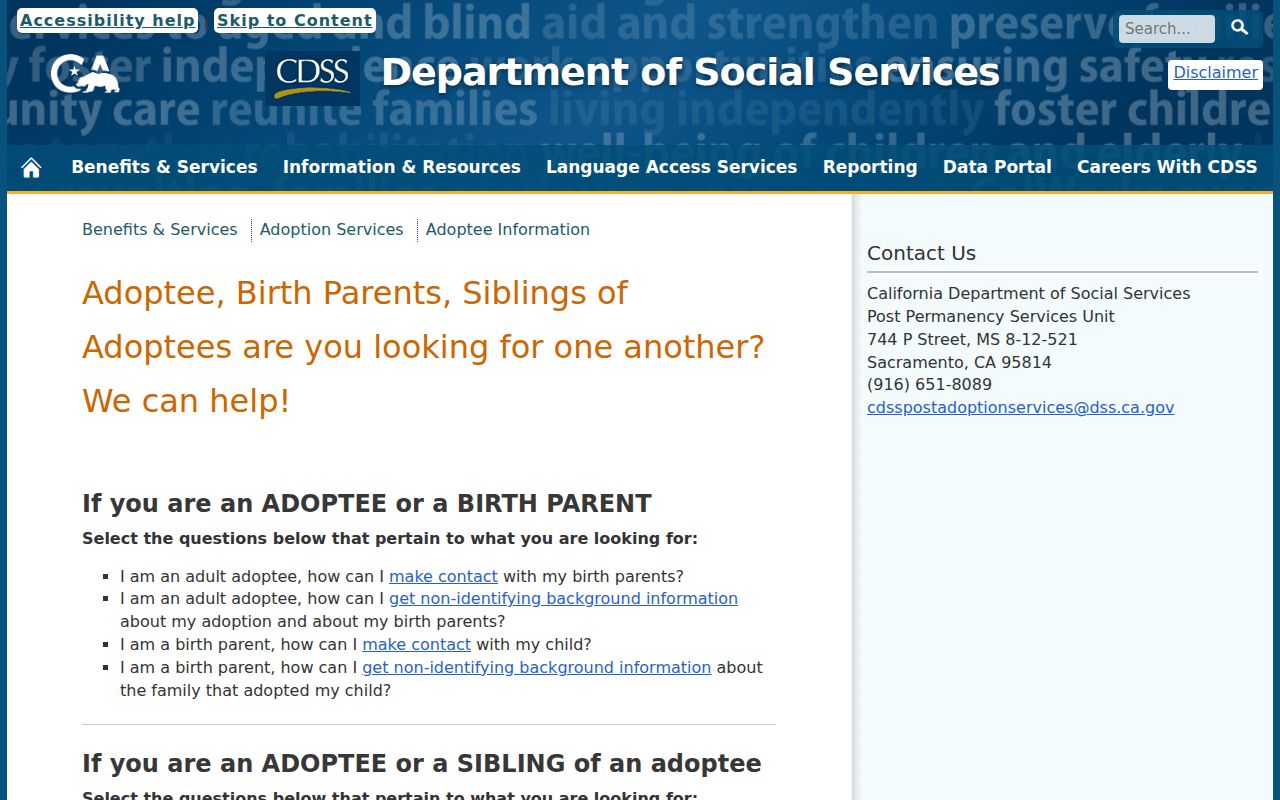
The image is a reminder that a resident lookup can have a formal eligibility path rather than an open search result.
Alhambra License and Business Clues
A distinctive business or professional detail can separate two people with the same name. California DCA searches by board, license type, license number, business name, first name, last name, or registry number. Bizfile Online searches entity names or numbers and can expose status, formation, agent, address, and dated filings where public. LA County fictitious-business-name records add a local trade-name route.
California's unclaimed-property search accepts last or business name, with optional first name, city, ZIP, or property ID. The Controller's unclaimed-property information route is the state record source. A match is a last-known-location clue and a claim requires documents. It is not proof of current residence. Search result fields should be copied with the date because status and public filings change.
The free California unclaimed-property search can add a dated name and city lead.
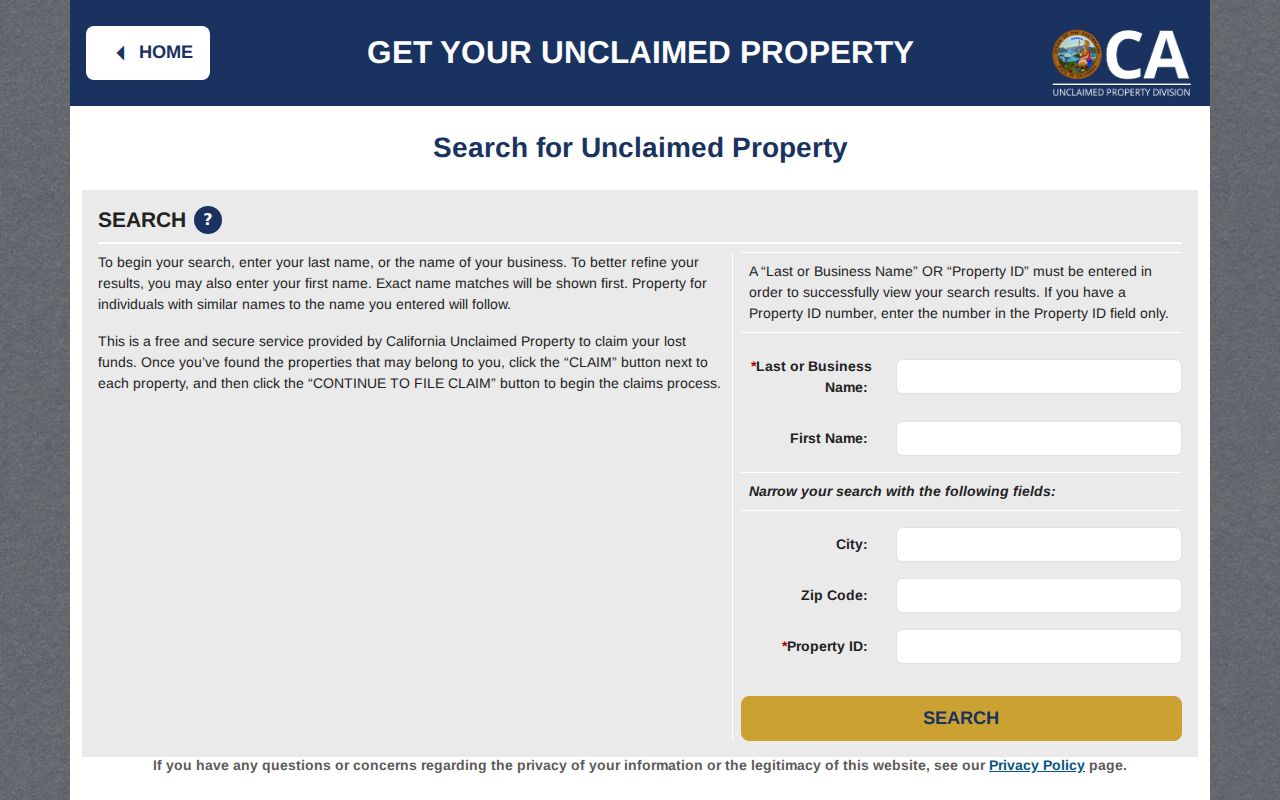
A commercial people-search category may supply a lead, but it can merge names, use stale data, charge for access, and lack custodian authority. Verify an important clue with DCA, SOS, RR/CC, the court, or the library instead.
Protected Alhambra Resident Lookup Records
Safe at Home can provide a substitute mailing address, mail forwarding, confidential voter registration, and an agent-for-service function for eligible survivors and certain public-facing workers. Confidential voter provisions can keep address details out of ordinary results. The program does not rewrite a deed, birth record, marriage record, or historical directory.
California Penal Code §646.9 addresses stalking, and Code of Civil Procedure §527.6 provides a civil-harassment route. The Driver's Privacy Protection Act limits motor-vehicle data. Voter statutes prohibit unauthorized use and transfer. A person who finds a wrong record should contact the custodian that maintains that record, not demand a citywide deletion.
The California Megan's Law public website is a narrow official public-safety registry, not a complete criminal-history search. Its use warnings matter. The Megan's Law public registry is the official source. Custody questions follow separate official channels: the Los Angeles County Sheriff's inmate search and the California CDCR locator.
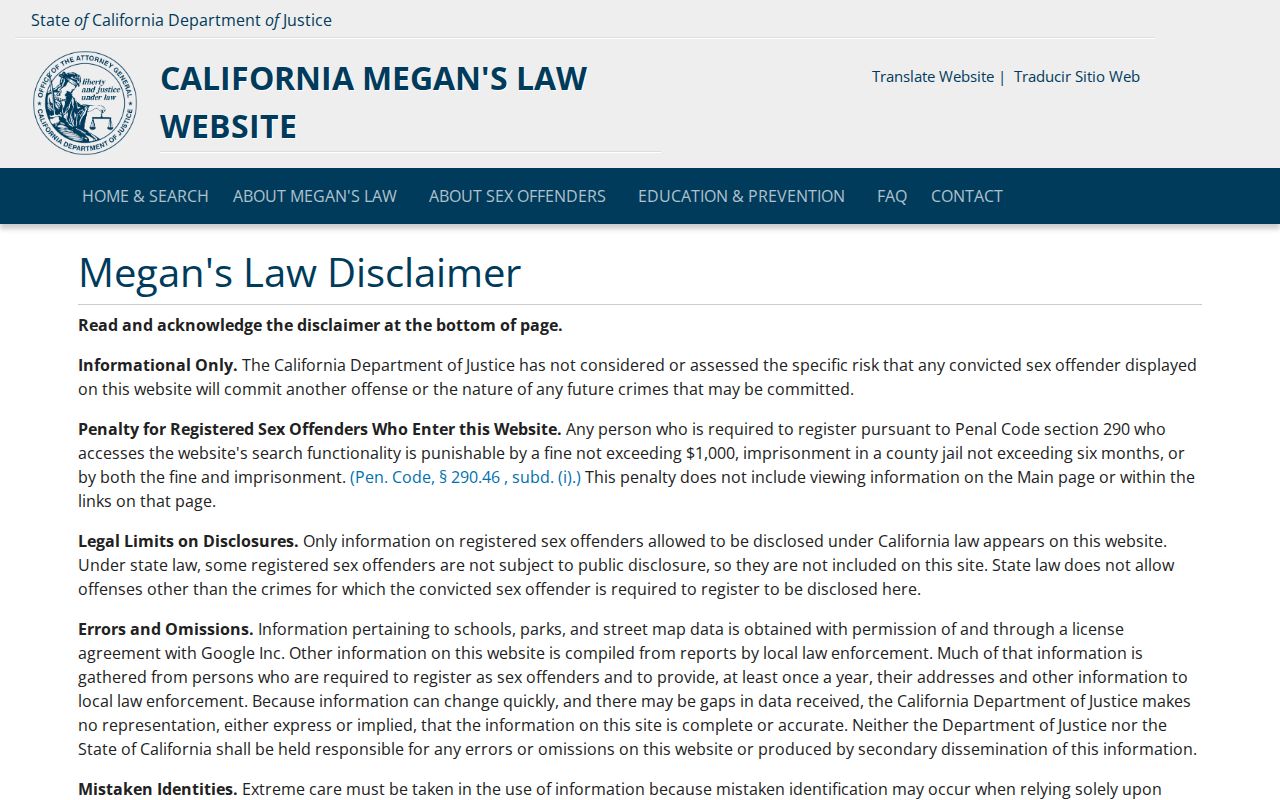
The result should be read only within its stated scope.
Lawful personal use: An Alhambra resident lookup is appropriate for family history, reconnecting, estate research, civic records, and personal safety awareness. Do not use any result to stalk, harass, intimidate, or harm another person.
When no portal works, use the correct fallback: City Clerk for an Alhambra municipal record, Police Records Bureau for a releasable police report, RR/CC for county records, CDPH for statewide vital orders, the court for case files, and the library or archives for historical material. A focused CPRA request under Government Code §§7920.000 et seq. asks an agency for an existing nonexempt record; it does not create a person search.